
7 Reasons Integrated Supply Chain Solutions Win for Retail
By Hal Justice
Scaling a CPG brand means managing increasing complexity. Adding SKUs requires better inventory systems. New retail partners bring different compliance requirements that must be tracked and met consistently.
The coordination burden compounds when brands use separate vendors for each logistics function. Managing timing across companies with no direct accountability to each other slows promotional launches and increases the chance of errors. Integrated operations remove this friction.
What You’ll Learn
- How single-provider operations reduce fulfillment costs
- Why unified systems prevent retail chargebacks
- The speed advantages of on-site co-packaging
- Meeting retailer compliance through automation
- Lower Costs Through Operational Efficiency
Using separate vendors for warehousing, co-packaging, and transportation means paying for products to move between facilities. Each transfer incurs freight costs, handling fees, and administrative overhead. Integrated operations eliminate these expenses by keeping everything in one location.
Bundled service pricing typically costs less than the sum of individual vendor rates. You manage one contract instead of negotiating with multiple providers. One invoice replaces reconciling charges across separate companies. Administrative time decreases substantially when you’re not coordinating shipments between vendors or resolving disputes about who’s responsible for delays. These savings compound over time, particularly for brands managing multiple SKUs or frequent promotional configurations through co-packaging services.
- Real-Time Visibility Across All Operations
When warehousing, co-packaging, and transportation share one warehouse management system, everyone sees current data simultaneously. Inventory updates happen in real time as products arrive. Co-pack work orders pull from actual counts. Transportation schedules reference completion status directly rather than waiting for phone calls between vendors. This visibility extends to retailer EDI systems and your ERP platform, where purchase orders, advance ship notices, and invoicing flow automatically without manual data entry between separate systems.
- Internal Accountability Prevents Failures
Separate vendors blame each other when problems occur. Integrated teams working for the same company support each other because failures affect everyone’s performance. Warehouse staff ensure co-packaging has products available on time. Co-pack supervisors complete work to meet transportation schedules. Transportation managers understand that late deliveries reflect on the entire operation.
“When all services report through the same management, teams help each other naturally. A customer chargeback doesn’t hit just one department, it affects everyone.” — [ Hal Justice, Vice President Sales and Operations]
This accountability matters particularly for food and beverage products where temperature control and allergen handling don’t stop at department boundaries. Unified operations maintain consistent protocols from receiving through final shipment.
- Faster Promotional Launches With On-Site Co-Packaging
When co-packaging happens at the storage location, transformations from bulk to retail-ready configurations complete in days instead of weeks. Warehouse staff pulls inventory directly to the co-pack line. Finished products move to outbound staging in the same building. No additional transportation, no extra handling, no coordination delays between separate facilities.
This speed helps with promotional timing. Brands can finalize label designs closer to launch dates, reducing risk of overproducing configurations that don’t sell. Beverage manufacturers or importers adjust gift pack quantities based on early sales data rather than committing months ahead. On-site operations also reduce damage from excessive handling—critical for temperature-sensitive products like premium chocolates or craft beer.
- Simplified Retailer Compliance Through Automation
Major retailers require specific labeling, precise advance ship notices, exact pallet configurations, and detailed traceability data. The FDA’s Food Traceability Rule taking effect January 2026 mandates lot-level tracking for many food products. Managing these requirements across separate vendors means each maintains data in different systems.
Integrated WMS and ERP systems track products through all steps—receiving, co-packaging, staging, shipment—maintaining lot codes, temperature logs, and handling records in one platform. When systems communicate directly rather than requiring manual data transfers, errors that trigger retailer chargebacks decrease substantially. Mistyped lot codes or incorrect ship dates happen less frequently when humans aren’t re-entering information between separate vendor platforms.
- Better Quality Control for Temperature-Sensitive Products
Products staying in one facility from receipt through retail configuration face fewer quality risks than items moving between separate vendor locations. Temperature-controlled environments managed by unified teams following consistent protocols maintain product integrity better than handoffs between companies with varying standards. This matters particularly for wine, craft beer, confectionery, pharma, and other items sensitive to temperature fluctuations. Fewer touches mean reduced damage, fewer temperature excursions, and better shelf presentation when products reach stores.
- Reduced Waste and Improved Sustainability
Moving products between separate facilities for warehousing, co-packaging, and outbound shipping generates unnecessary waste in time and fuel. Integrated operations eliminate these extra moves. Products flow from receiving dock to co-pack line to outbound staging within one building, substantially reducing the carbon footprint of fulfillment operations.
Less handling also means less packaging waste. Products don’t need protective materials for transit between vendors. Damaged inventory requiring disposal decreases when items aren’t repeatedly loaded, unloaded, and transferred. For brands with sustainability commitments or retailers requiring environmental reporting, these improvements provide measurable benefits.
Frequently Asked Questions
How much can brands typically save through integrated operations?
Savings vary by volume and complexity, but brands can reduce fulfillment costs when factoring in eliminated inter-facility transportation, bundled service pricing, reduced chargebacks, and lower administrative overhead from managing a single provider versus coordinating multiple vendors.
What retailer systems do integrated 3PLs connect with?
Established providers maintain EDI connections with Walmart, Target, Kroger, Whole Foods, and major regional chains. These automate purchase orders, advance ship notices, invoices, and inventory updates. Many also integrate with Amazon Vendor Central and provide direct API connections for real-time retailer data exchange.
How quickly can promotional co-packaging projects launch?
Simple label additions or bundling typically complete in 2-5 business days from approval. Complex configurations like gift sets might require 5-10 business days. On-site operations eliminate transportation time between facilities and reduce approval loops since teams work together.
Can integrated providers handle omnichannel fulfillment?
Yes. Integrated operations manage retail distribution, e-commerce fulfillment, and B2B shipments from shared inventory. The WMS allocates inventory across channels, co-packaging configures products for different requirements, and transportation arranges appropriate carriers. This prevents overselling and allows shifting inventory based on demand.
What capacity flexibility do integrated providers offer?
Unified operations can shift resources between services as needed. When co-packaging volume spikes, warehouse personnel support packing temporarily. When transportation faces constraints, providers adjust outbound schedules more easily than separate vendors negotiating changes. This flexibility helps manage seasonal demand variations.
How do integrated operations maintain food safety?
Single-company operations follow consistent protocols from receiving through shipment. The facility maintains uniform temperature controls, allergen procedures, and sanitation standards across warehousing, co-packing, and staging. Staff receive unified training rather than different standards from multiple vendors, reducing compliance risk and simplifying audits.
Making Integration Work
Retail partnerships demand precision. Chargebacks, order reductions, and product drops happen when fulfillment operations fail to meet requirements. Using separate vendors for each logistics step creates unnecessary coordination complexity and eliminates direct accountability.
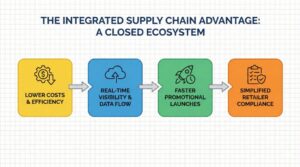
Integrated providers managing warehousing, co-packaging, and transportation as unified operations reduce costs through bundled pricing and eliminated inter-facility moves. They improve delivery performance through shared systems and internal accountability. They accelerate promotional launches with on-site co-packaging. They simplify retailer compliance through automated data exchange.
Atlanta Bonded Warehouse operates facilities where food-grade storage, co-packaging lines, and outbound transportation function as coordinated operations. For brands building retail partnerships while controlling fulfillment costs, this integration provides capabilities fragmented vendors cannot deliver. Thinking about how integrated supply chain services could simplify your brand’s growth? Reach out to us, and let’s start the conversation.